
London's "Affordable Rent" Programme - by Colin Wiles

Has there ever been a major housing delivery programme as shrouded in secrecy as the “Affordable Homes” scheme?
When I wrote about this on previous occasions I had to make Freedom of Information requests in an effort to obtain meaningful figures. Even the figures that are now being produced are lacking in detail and hard to decipher.
It’s as if those in charge of the scheme are doing it from a dark doorway, like Private Joe Walker, the spiv from Dad’s Army: “Ere Guv, fancy making a few million quid off the back of yer tenants and the taxpayer, just stick the rents up, sign ’ere, don’ tell no one, a’right?”
This has been neatly illustrated by the attempts to decipher the latest figures from the GLA. Like The Guardian I estimated that 25,217 social rented homes had been “converted" to “affordable rent” in London since the scheme began. The Guardian reckoned that this had brought in an extra £70 million for London landlords, much of it funded by the taxpayer through higher housing benefit costs. Not so, said the GLA. The figures in their tables are cumulative and the true figure for conversions is 11,011 with an increase of £50 million in rents. The Guardian has since amended their article, and I have amended this one.
I defy anyone to look at the GLA tables and conclude that the figures are cumulative. There is not a single note or reference to this effect. It’s only when you have been told this and work through the spreadsheets that you realise the numbers are rising quarter by quarter. As I said at the outset, this programme is not transparent.
Despite this, I still find the figures on conversions quite shocking. Admittedly, 11,011 social rent homes is not as shocking as 25,,217 but it is still a significant figure, more than the number of social rented homes lost to the right to buy over the same period. This has been allowed to happen with almost no public debate, even though social rented homes, in the context of London’s dysfunctional housing market, should be treated like precious gems and preserved at all costs.
56% of the conversions that have taken place since the “Affordable Rent” regime began are in the stock of six major housing providers, as follows:
- London & Quadrant - 1,673
- Circle - 1,381
- Affinity Sutton - 1,182
- Notting Hill - 867
- Guinness - 638
- Peabody - 394
Over the last year the average rents for converted stock in London has been set at 65 percent of market rent (some are at 80 percent and some are much lower). Housing providers argue that they are mitigating the worst impacts of “Affordable Rent” by keeping well below the 80 percent cap, but the impact on tenants is still considerable.
Take an example from two inner London boroughs. Southwark is a mid-table inner London Borough (i.e. not the richest and not the poorest). Average housing association social rents are around £116 per week, whereas the mean market rent, based on VOA figures, is £345 per week.
So a conversion from a social rent to 65% of the market rent means an increase from £116 a week to £207 a week, a 78% increase.
In Camden the average social rent is £127 per week and the mean PRS rent is £472 per week (the median is £399 because there are many more high end properties in Camden). Just taking the median rent, this means an increase from £127 per week to £259 per week, more than double the social rent.
Is it surprising that the average affordable rent in London for a two-bed newbuild has just breached the £1,000 a month mark? However you look at the figures, these new rents are simply unaffordable to anyone on a low wage without recourse to benefits. There is a real risk that this is creating a growing stock of so-called “affordable homes’ where people will be trapped on benefits until they move or die.
There is no doubt that many housing providers are caught in a cleft stick. Commendably, they want to carry on building homes to tackle the housing crisis. Yet the current funding framework means they have to charge rents on existing, as well as new, homes, which are well beyond the means of the “hard-working families” politicians are so fond of talking about.
The regulatory framework requires the Boards of housing associations to act as the “custodians of social housing assets” and you wonder how long they can continue to wander down this path of unaffordability.
Perhaps Boards should be asking themselves searching questions about whether it is right to carry on this way. Perhaps they should instead call policy-makers’ bluff and say: “Current policy is not sustainable, for people who need housing, for us as businesses, or for the taxpayer. We will only build more homes if they are at rents which hard-working families can pay without recourse to benefits.”
This article first appeared on the 24 Dash website
SHOUT at Homes For Britain

Along with the other SHOUT campaigners I was pleased to attend The Homes For Britain rally on Tuesday 17th March 2015. It was fascinating to see a great mix of housing group representatives, campaigners, politicians and tenants pouring into the Westminster Central Methodist Hall, and we were proud to add our voice to the diverse chorus calling to end the housing crisis.
It is our intention to make the provision of social rented housing a core element of any offering to solve the housing crisis. We therefore found it really encouraging that the loudest cheers and applause from the audience came when speakers mentioned that it was clear the only way to meet the level of housing supply required to solve the housing crisis would be through reinvigorating government investment in building social housing.
Read moreBuilding on History
In order to make sense of the present we need to understand the past. The buildings that surround us did not arrive by accident; they are the result of political and policy decisions that often involved months and years of public debate. But the best buildings are often those that were founded on a strong vision about creating a better future.
Tomorrow, the Homes for Britain rally takes place in Westmister. Four miles to the north east is the Boundary Estate in Shoreditch. For those who don’t know, it replaced the slums of the Old Nichol that were graphically portrayed in William Morrison’s novel ‘A Child of the Jago' (there is now a trendy retro shop of that name nearby). It was the first major London County Council estate and was built as a result of the Housing of the Working Classes Act of 1890, which allowed local authorities to clear slums and build new homes. It comprises twenty majestic six-storey blocks radiating from the raised mound of Arnold Circus, (which was created from the rubble of the Jago slums). It is designed in the arts and crafts style and was completed in 1900. The brickwork is beautiful. It’s only a few minutes walk from Liverpool Street station and if you are in the neighbourhood I urge you to go and look at it.
Just three years after it was built Jack London published "The People of the Abyss", his account of the terrble conditions in the East End. The Boundary Street estate showed that municipal action could help to turn the tide against poverty and poor housing.
Thanks to the wonderful people at Municipal Dreams I was referred to W.Thompson’s Housing Handbook of 1903 and have been able to uncover the financial history of the Boundary estate.
The bare facts are these: 1,044 flats were built, ranging from one to six bedrooms, plus a laundry, workshops and shops. Rents in 1900 ranged from 3/6 (17.5p) a week for a one-bed flat to 14 shillings (70 pence) a week for a six-bed flat. In today’s money, allowing for inflation, that’s £18.80 to £75 a week. Of course land, labour and materials were cheaper then, and rent and house price inflation have not followed the same trajectory as general inflation.
But it’s when you look at the construction costs and subsequent rent flows that it becomes interesting. The flats cost £280,000 to build and the land cost was £61,760, a total of £341,760 or £36.6 million in today’s money. So each flat cost less than £327 to build, which is £35,000 at today’s prices.
The annual income from rents was £20,343 (£2.183 million today). Since Right to Buy was introduced in 1980 about half of the flats have been sold. Even so, the ratio of capital cost to annual income during its first 80 years was around 17 to 1. So in very crude terms the scheme paid for itself after seventeen years. Of course you need to work out the net income to calculate how soon the scheme would 'wash its face' as development staff would say. But even after deducting management, maintenance, capital refurbishment and other costs the scheme must have paid for itself several times over. Had this been a private estate the surplus (or profit) would have gone into the pockets of shareholders, but this being a municipal scheme the surplus, subject to Treasury intervention, has been re-invested in other council-built homes in Tower Hamlets.
That is the beauty of social rented housing – tenants and taxpayers of the past pay for current schemes, and inflation wipes away historic debts. It is truly a communal enterprise that benefits everyone - the tenant, the taxpayer and wider society. A quick look at the global accounts of housing providers shows that historic debt, including grant, is a fraction of current realisable values. Taken as a whole the entire enterprise is in surplus because of the long historical timeline. There is no more profitable form of public investment than investment in real estate. Above all, the low rents that arise from the absence of siphoned-off profits, allow people to work without being trapped on benefits.
History also shows us that private housebuilders on their own cannot meet the need for new homes. The last time they built more than 200,000 homes a year was in 1968 and only in seven of the forty six years since then have they built more than 150,000 homes a year. Regardless of demand-side stimulii like Help to Buy or Starter Homes they simply will not boost their production to meet either need or demand. This is why direct government investment, preferably in the form of social rented housing, is the missing element that must form a key part of any future housing programme and why the SHOUTcampaign is so important. Fixing the housing crisis within a generation is a noble ambition, but the only way we can build more than 200,000 homes a a year is by including a significant role for social housing.
The history lesson is as clear as it could be. Social rented housing works. It eases pressure on the private rented sector, it helps to reduce the housing benefit bill (even Policy Exchange admits that social housing saves £3 billion a year on HB) and it rescues people from bad housing conditions, providing decent homes at rents people can afford. Most importantly, it pays for itself over time and becomes a valuable public asset that produces "profits" for the public good. It proves the point that the best concepts should never be allowed to die, they just need to be re-discovered and re-made to meet modern requirements. Just because a concept is old doesn’t mean it is old fashioned and irrelevant to present day problems.
(This blog by Colin Wiles also appears on the Inside Housing website.)
Read moreLondon Assembly passes motion to support SHOUT
The London Assembly has passed a motion in support of SHOUT, calling on the Mayor, Boris Johnson to publicly support our campaign. The full text of the motion, proposed by Darren Johnson AM and seconded by Andrew Dismore AM reads as follows:
-
“This Assembly believes that building social rented homes must be the core of the Mayor’s strategy to tackle London’s housing crisis.
This Assembly regrets that funding social rented housing has become increasingly marginalised in favour of the less affordable and less secure ‘affordable rent’ policy, and regrets that existing social rented homes are being lost due to conversions to affordable rent, sales through the revived right to buy and demolitions assisted by the Estate Regeneration Fund.
This Assembly therefore resolves to support the SHOUT (Social Housing Under Threat) campaign, taking a lead in affirming the positive value and purpose of social rented housing. This Assembly also calls on the Mayor of London to publicly support the campaign, and to consider how the GLA can deliver a programme of new social rented homes.”
Reflecting on the NHF Leadership summit
I read a lot of blogs, articles and Tweets about SHOUT (Social Housing Under Threat)
I despair at the continuous demand for more social housing when we are selling more and more of our social homes daily. We heard a couple of weeks ago that a possible "giveaway" of our social homes has been mooted too. I know that too much of what we hear from central Government is policy based in and around London and believe that there is an obvious, albeit unspoken, desire to release social homes to the market so they can be purchased and privately rented. The not-so-subtle message seems to be let's get rid of social homes altogether.
Read moreWhere will poor people live?
Tom Murtha is one of the founding members of SHOUT, and as with the rest of the team has strong personal reasons for wanting to ensure that people can be provided with safe homes that they can afford to live in. In this blog for Inside Housing, Tom shares some of those reasons, asking some of the questions that are often ignored in the flurry of housing public relations.
This article originally appeared on Inside Housing, and is reproduced here with the kind permission of the author.
They say that you always remember the first time. The first time that you give someone the keys to a new home, that is. I still remember mine. I was working in the inner city of Leicester in the late 1970s. As part of my job I visited people who had applied for a home. I arrived at the address. The property looked derelict but there on the first floor I found an elderly African/Caribbean couple. Through no fault of their own they were living in squalid conditions.
Read moreSocial Housing and The Great War
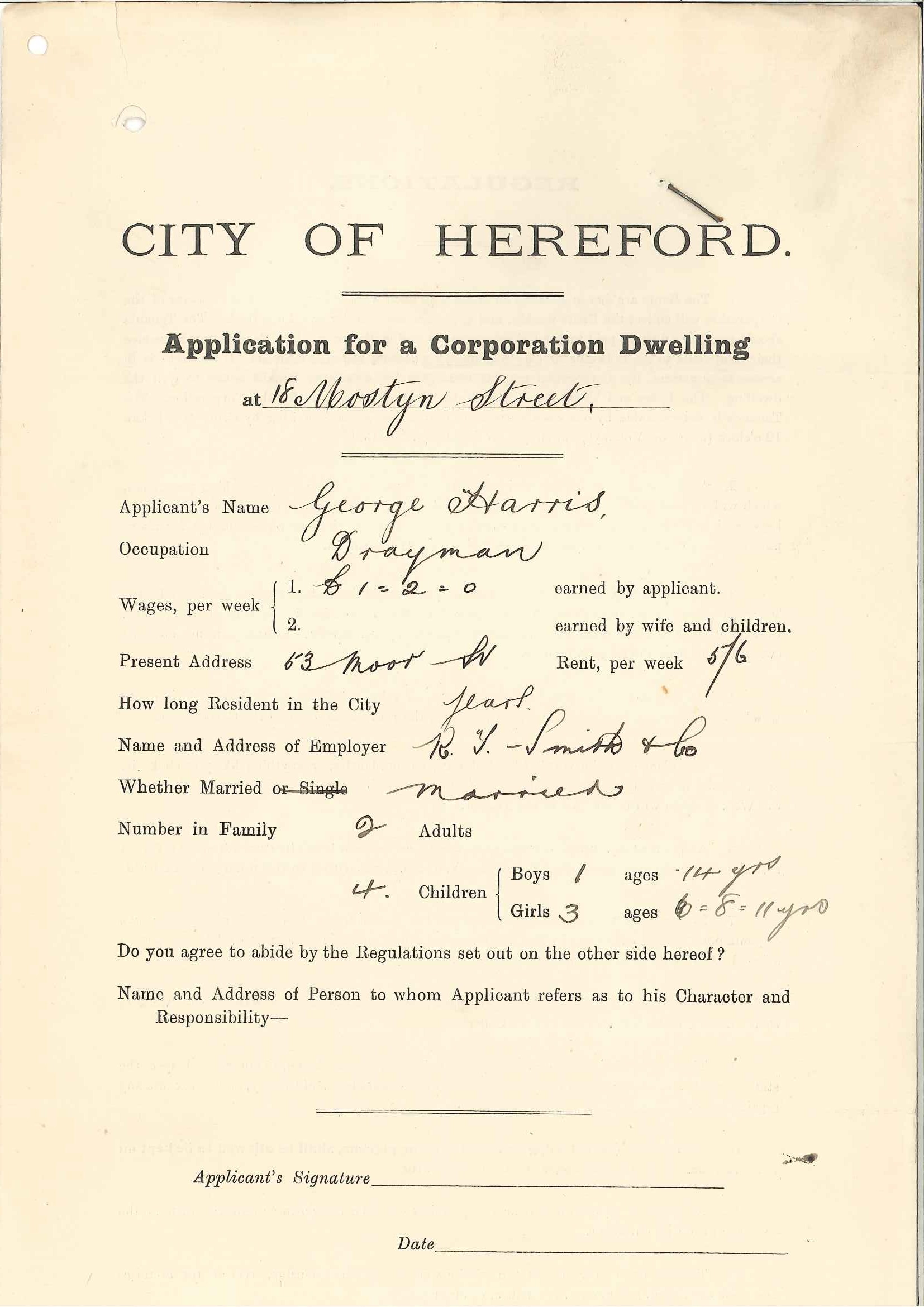
1915 application form
We stumbled across an old tenancy file recently for a house in Mostyn Street, Hereford, first opened during the early years of the First World War. Mr and Mrs James moved in to their new house on 6th March 1915 – four days before the start of the battle at Neuve-Chappelle in which 22,000 men lost their lives over two days. The tenancy agreement reflects the concerns of the time. If anyone has an infectious disease the tenant “must agree to allow the person affected to be removed to Hospital…” And “Tenants are not allowed to paper, paint, or drive nails into the walls or woodwork without the consent of the Collector.” The Collector was a powerful man.
Read moreIt's not just about the numbers

Despite some difficulties in getting the message across, and varying opinions on how the funds can be made available, Tom Chance blogs exclusively for SHOUT to explain why the Green Party feels so strongly about building 500,000 social rented homes by 2020.
Here Tom Chance, the Green Party spokesperson for Housing, blogs for SHOUT on the personal factors that went into the formulation of the policy.
The Green Party has pledged to build 500,000 social rented homes during the course of the next Parliament. But our pledge isn't only about numbers, it's also about the value of social housing.
We want to bring housing back as one of the pillars of the welfare state. We should be able to collectively rid every citizen of the fear that they may not be able to feed their family, get an education for their children, receive treatment when sick, or keep a roof over their heads.
Read moreThe Good Right suggests a Conservative government must consider building Social Housing
Conservative Party activist Tim Montgomerie has launched a 12-point manifesto for 'compassionate conservatism', the first point of which lays out the importance of investment for government-funded construction of social housing.
Read moreGreen Party plan for social housing laid out in Inside Housing
Following on from our recent report that the new Green Party policy on social housing is a victory for SHOUT, Tom Chance, who is the Green Party candidate for Lewisham West and Penge, has written a blog on Inside Housing offering more detail about the Green Goals to build 500,000 social rented homes by 2020. The party also has an ambition "to put social housing back at the heart of government policy".
Read more